
English to High Valyrian Translator
Explore Our Latest Tools!
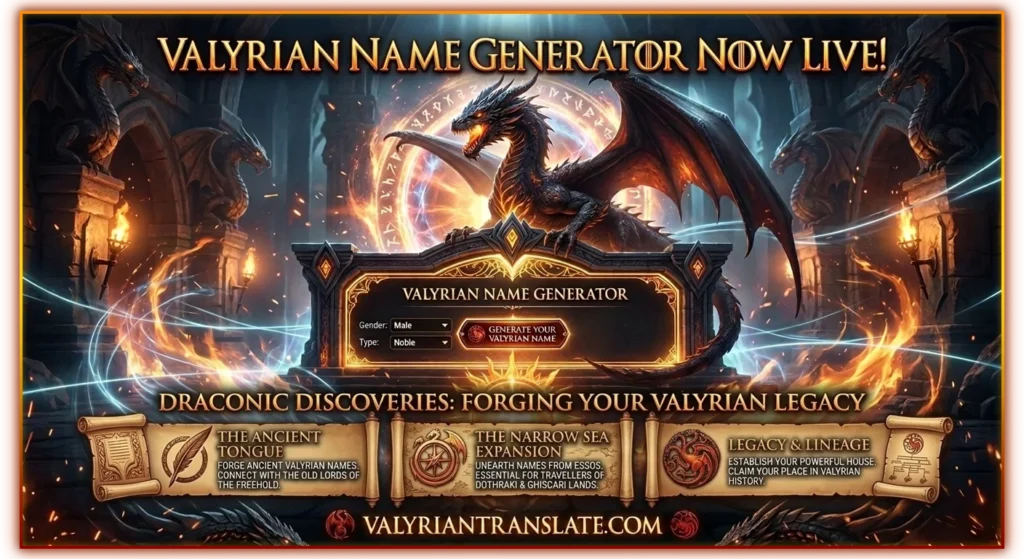
High Valryian Name Generator
Create authentic Valyrian names for your Targaryen characters, dragonlords, and noble houses. Generate lore-accurate names following the phonetic patterns of Old Valyria—perfect for fanfiction, roleplay, and original characters in the world of ice and fire. Try Valyrian Name Generator
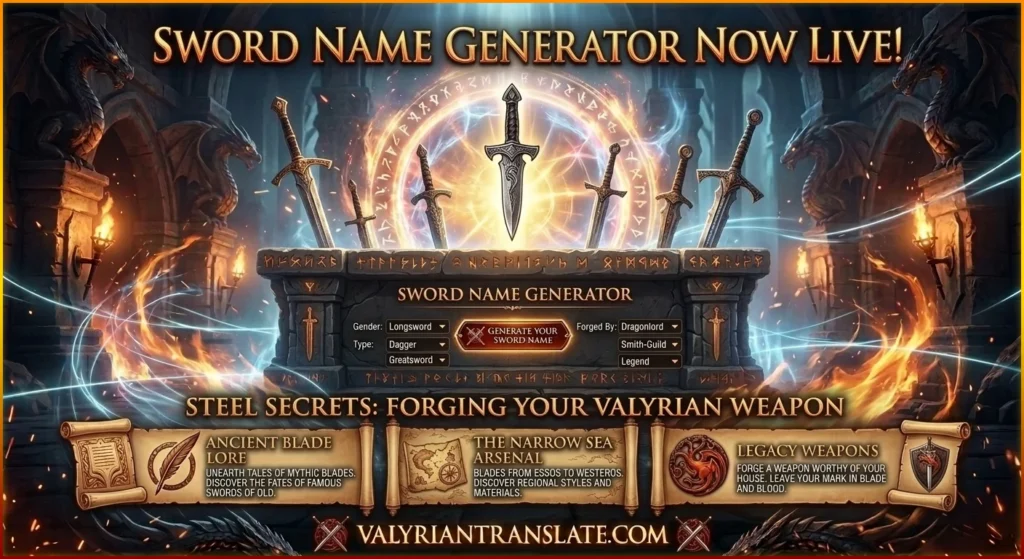
SWORD NAME GENERATOR
Sword Name Generator Create legendary Valyrian and fantasy sword names with authentic Game of Thrones-style phonology. Perfect for writers, RPG players, and worldbuilders seeking epic blade names with meaning.
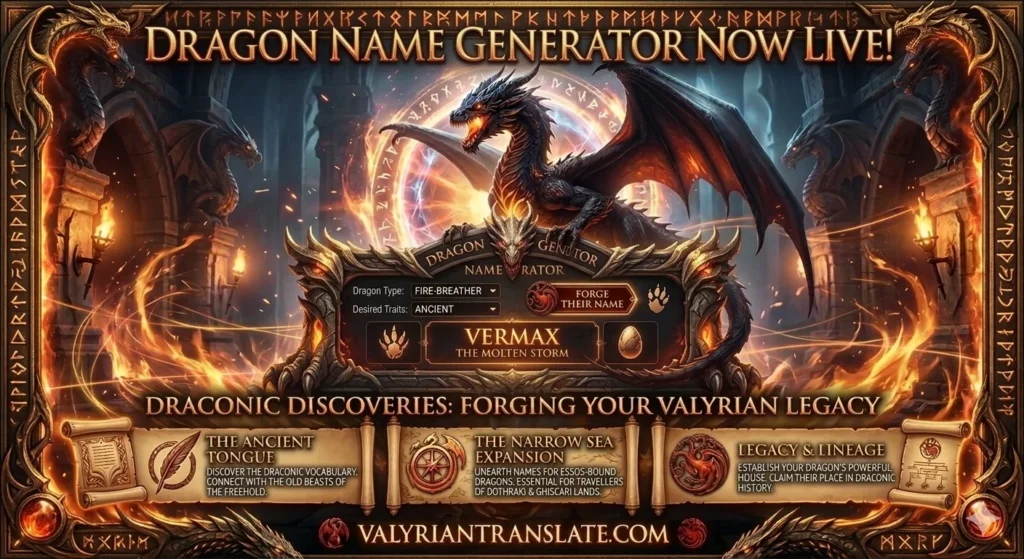
DRAGON NAME GENERATOR
Create powerful and unique dragon names using our dragon name generator. Generate Valyrian, mythic, and fantasy dragon names with deep meanings for your stories, games, and worldbuilding.
For many fans of Game of Thrones and House of the Dragon, curiosity about the Valyrian language begins with a simple question: can you actually translate English into High Valyrian?
High Valyrian is not just a collection of dramatic phrases like “Dracarys” or “Valar Morghulis.” It is a carefully designed constructed language with real grammar, pronunciation rules, and vocabulary created by linguist David J. Peterson for HBO’s television universe.
This page introduces a tool designed for fans, writers, and language learners who want to explore the language more deeply. Whether you want to translate a short phrase, study vocabulary, or understand how High Valyrian grammar works, this guide explains the fundamentals of the language and how translation works. By the end of this article, you will understand:
• What High Valyrian is and where it comes from
• How a Valyrian translator works
• The basics of High Valyrian pronunciation and grammar
• Famous phrases used in the series
• How learners can start understanding the language beyond simple translation
What is High Valyrian?
High Valyrian is a fictional language developed for the HBO series Game of Thrones and later expanded in House of the Dragon. Within the fictional world, it was the ancient language of the Valyrian Freehold, a powerful civilization that once ruled much of Essos.
After the destruction of Valyria, the language gradually fragmented into regional dialects known collectively as Low Valyrian. High Valyrian, however, survived as a prestigious language used in:
• noble speech
• ceremonial traditions
• historical texts
• dragon commands
Members of House Targaryen, including Daenerys Targaryen and Rhaenyra Targaryen, frequently speak High Valyrian in the shows.
Unlike many fictional languages that consist of a few invented phrases, High Valyrian was built using real linguistic principles. It includes:
• a structured grammar system
• multiple noun cases
• verb conjugations
• phonological rules
• thousands of documented words
Because of this structure, High Valyrian can actually be studied and learned like a real language.
Why Use a Valyrian Translator?
Most “fantasy translators” on the internet simply replace English words with memorized quotes from the shows. You can explore High Valyrian negation rules to understand how negative sentences are formed in real Valyrian structure. That approach works for a handful of famous lines but fails when translating original sentences.
This includes:
• recognizing vocabulary from the High Valyrian lexicon
• applying grammatical rules when possible
• generating phrases that resemble authentic Valyrian sentence structure
Such tools can be useful for several purposes:
Language Learning
Students exploring High Valyrian can use a translator to test vocabulary and see how words appear in sentences.
Creative Writing
Fan-fiction writers and role-players often incorporate Valyrian dialogue to add authenticity to their stories.
Cultural Exploration
Many fans enjoy studying the language because it adds depth to the fictional world created by George R. R. Martin.
Social Media and Fandom
Short phrases in High Valyrian are commonly used in memes, captions, and community discussions.
It is important to remember that High Valyrian vocabulary is still expanding, so not every English word has a direct translation.
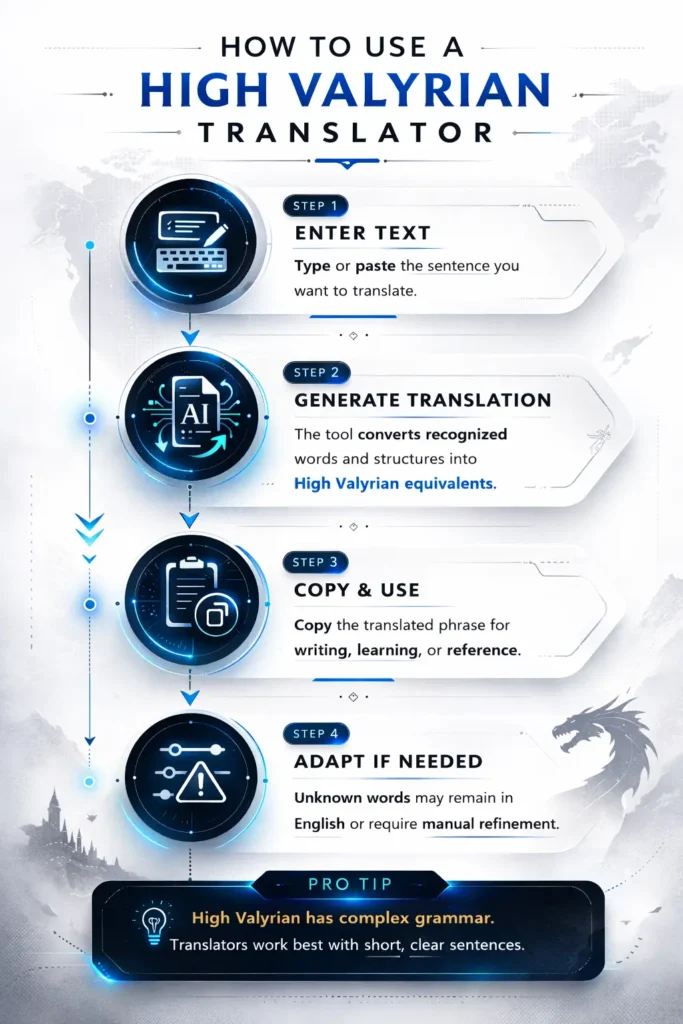
How to Use a Translator
Using a translator is usually straightforward.
- Type or paste the sentence you want to translate.
- The tool attempts to convert recognized words and structures into High Valyrian equivalents.
- You can copy the translated phrase for writing, learning, or reference.
- If certain words do not exist in the Valyrian vocabulary, they may remain in English or require manual adaptation.
Because High Valyrian has a complex grammar system, translators work best with short sentences and clear phrasing.
Pronunciation Guide
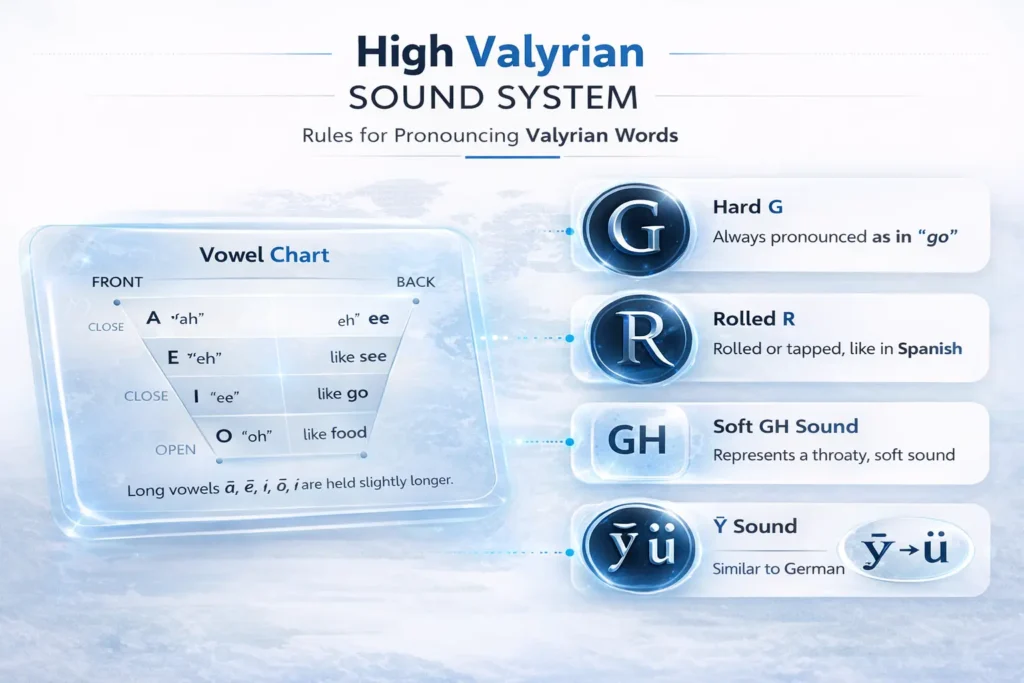
One of the most distinctive aspects of High Valyrian is its sound system. The language draws inspiration from classical languages such as Latin and Greek but maintains its own phonetic identity.
Basic Vowel Sounds
High Valyrian vowels are pronounced clearly and consistently.
Letter | Approximate Sound | Example |
A | “ah” | like father |
E | “eh” | like bed |
I | “ee” | like see |
O | “oh” | like go |
U | “oo” | like food |
Long vowels are written with macrons (ā, ē, ī, ō, ū) and are held slightly longer in pronunciation.
Consonant Characteristics
High Valyrian consonants generally follow predictable rules.
Important pronunciation traits include:
• G is always hard, as in “go”
• R is rolled or tapped, similar to Spanish
• Double consonants are lengthened when spoken
• GH represents a soft, throaty sound
For example:
Rytsas (hello)
Pronunciation: REET-sahs
Unique Phonetic Feature: The Letter “ȳ”
One distinctive sound in High Valyrian resembles the German ü. It is written with a macron:
ȳ
This sound appears in words such as:
Sȳz – good
Knowing why word order matters in High Valyrian improves pronunciation rhythm and meaning.
Understanding High Valyrian Grammar
High Valyrian is an inflected language, meaning that word endings change to indicate grammatical relationships. This is similar to languages such as Latin or Ancient Greek.
Three core systems define the language:
• grammatical gender
• noun cases
• verb conjugation
The Four Grammatical Genders
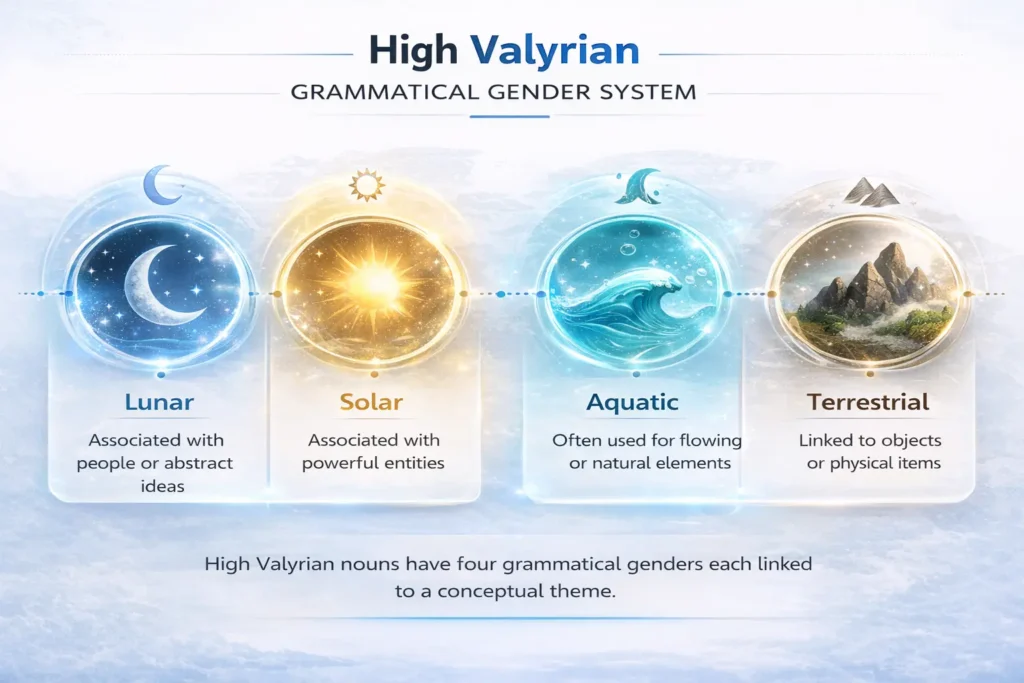
Instead of masculine and feminine categories, High Valyrian organizes nouns into four grammatical genders:
Gender | Conceptual Theme |
Lunar | associated with people or abstract ideas |
Solar | associated with powerful entities |
Aquatic | often used for flowing or natural elements |
Terrestrial | linked to objects or physical items |
These genders influence how adjectives and verbs agree with nouns.
The Case System
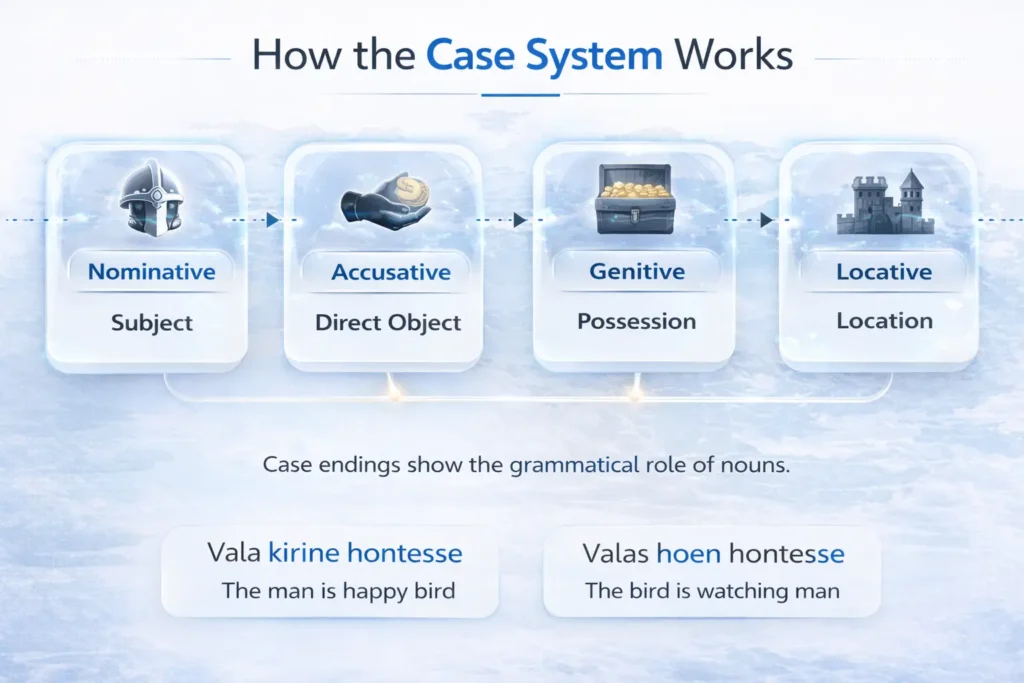
High Valyrian nouns change form depending on their role in a sentence. If you struggle with noun forms, check out High Valyrian case system confusions for clarity. The language includes eight grammatical cases, such as:
• nominative (subject)
• accusative (direct object)
• genitive (possession)
• dative (indirect object)
• locative
• instrumental
• and others
Because case endings carry grammatical meaning, word order can be flexible.
For example, both sentences below can express the same idea depending on case endings.
Noun Plurals
Plural forms often involve vowel changes or suffixes.
Examples:
Singular | Meaning | Plural | Meaning |
vala | man | vali | men |
hontes | bird | hontesse | birds |
zaldrīzes | dragon | zaldrīzesse | dragons |
Adjective Agreement
Adjectives must match nouns in gender, number, and case.
Example:
Ñuha zaldrīzes
“My dragons”
• Ñuha = my
• zaldrīzes = dragons
If the grammatical role changes, both the noun and adjective forms may change as well.
Verb Conjugation
High Valyrian verbs change based on tense and number.
Example with the verb lanta (to sing):
Gender | Conceptual Theme |
lanta | he/she sings |
lantāpti | they are singing |
Verb endings provide information about who performs the action. A related topic is active vs passive voice in High Valyrian useful for sentence construction.
Common High Valyrian Words and Phrases
Several High Valyrian phrases became famous through the shows.
High Valyrian | English Meaning | Context |
Dracarys | Dragonfire | Command to dragons |
Kessa | Yes | Affirmation |
Daor | No | Negation |
Valar Morghulis | All men must die | Traditional greeting |
Valar Dohaeris | All men must serve | Response to the greeting |
Ñuha avy | My friend | Friendly address |
Avy jorrāelan | I love you | Personal expression |
Sȳz bantis | Good night | Formal farewell |
These phrases demonstrate how the language appears in both formal and emotional contexts. High Valyrian sentence structure guide
Famous Quotes
Valyrian Quote | Meaning | Context |
Valar Morghulis | All men must die | Philosophical phrase |
Valar Dohaeris | All men must serve | Traditional response |
Ñuhor līr gūrēnna | I will take what is mine | Declaration of power |
Tubī daor | Not today | Defiance against fate |
These phrases are memorable not only for their meaning but also because they are embedded in powerful scenes throughout the shows.
High Valyrian in the World of Westeros
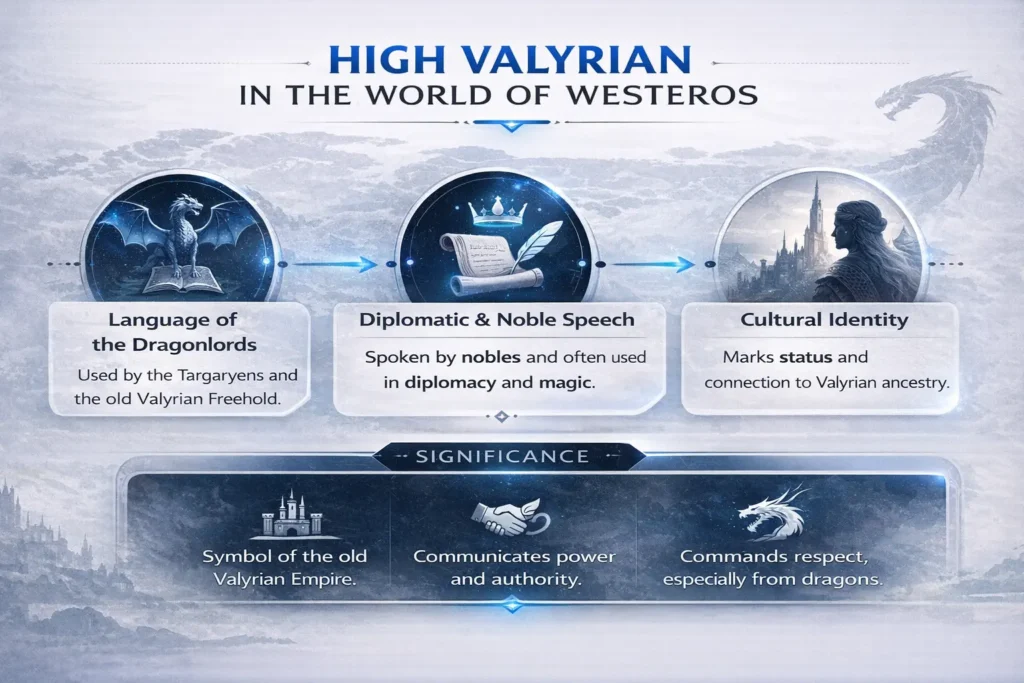
High Valyrian plays an important role in the narrative of the series.
Language of the Dragonlords
The Targaryens inherited High Valyrian from their ancestors in the Valyrian Freehold. It became a symbol of lineage and authority.
Diplomatic and Noble Speech
Characters such as Missandei often use the language to translate and communicate across cultures.
Cultural Identity
Speaking High Valyrian marks characters as educated, noble, or connected to Valyrian heritage.
FAQs
High Valyrian continues to fascinate fans because it combines storytelling, linguistics, and world-building. Whether you are translating a short phrase, studying grammar, or simply exploring the language of the dragonlords, learning High Valyrian opens a deeper connection to the universe of Westeros.
Written by Fareed, a linguist enthusiast and Game of Thrones fan exploring fictional languages. Learn more about Author